
GRANT GARRISON LTD. / FUTURE FILE 003
PHYSICAL AI
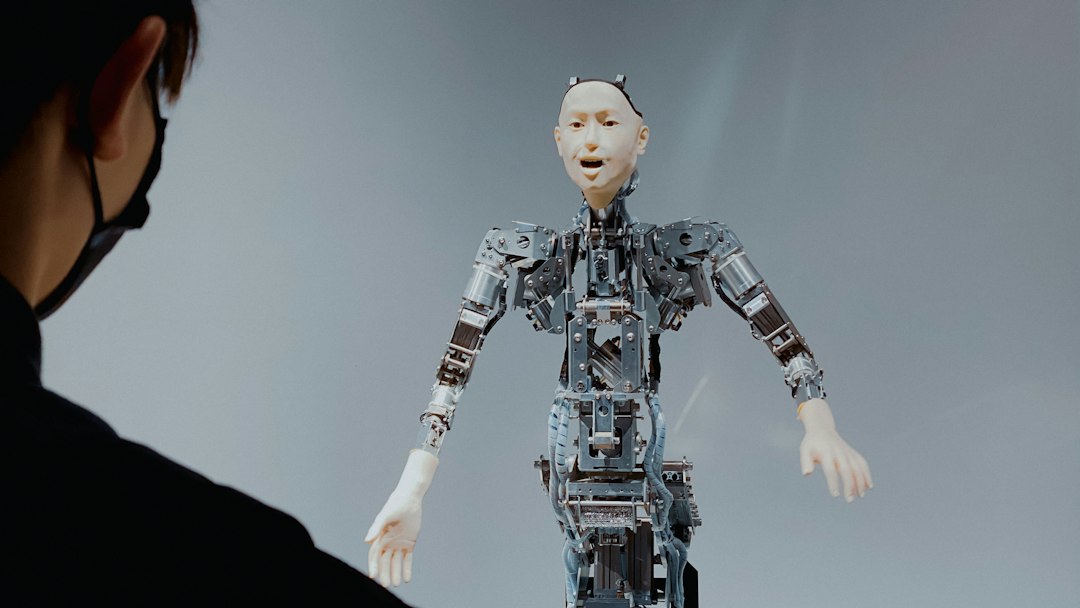
The moment intelligence climbs out of the screen, design stops being a rectangle problem.

01 / THE SCREEN WAS ONLY THE FIRST HABITAT
For most people, artificial intelligence still arrives through a rectangle. We type, speak, upload, wait and receive. That interaction model is already changing. Research and industry signals in 2026 increasingly point toward AI moving into robots, vehicles, cameras, industrial equipment and ambient environments. Once intelligence can perceive a room and affect the physical world, the creative brief changes completely.
A physical system has weight, inertia, reach, noise, heat, latency and consequences. A bad button can frustrate you. A badly behaved machine can block a hallway, damage an object or frighten a person. That makes physical AI simultaneously more exciting and more demanding than another generation of software features.
02 / THE REAL INTERFACE IS BEHAVIOR
Imagine a studio assistant that can move lights, fetch equipment and prepare a set. Its interface is not merely the tablet used to configure it. The interface is how quickly it approaches, where it stops, whether it interrupts, how it signals uncertainty and what it does when the room becomes unpredictable. Motion becomes language.
This is where designers can borrow from animation, filmmaking, architecture and theater. A machine entering a room has staging. A pause has meaning. A light can communicate state. A sound can reassure or irritate. The physical product is constantly performing its internal model of the world.
The robot is not the interface. Its behavior is.
03 / FROM COMMANDS TO COLLABORATION
Traditional automation loves predictable environments. The emerging promise of physical AI is adaptation: machines that can recognize changing conditions and choose among possible actions. That does not mean autonomy should be unlimited. In fact, the most elegant systems may be the ones that make their boundaries unusually legible.
A collaborator should know when to proceed, when to ask and when to stop. The same principle applies to an autonomous camera rig, warehouse robot, home system or vehicle. Confidence needs a visual and behavioral grammar. If the machine is uncertain, the human should be able to see that uncertainty before it becomes an unpleasant surprise.
04 / THE NEW LUXURY IS INVISIBLE COORDINATION
There is a version of the future where every object talks constantly. It sounds unbearable. The more compelling future is quieter: systems coordinate in the background and surface themselves only when human judgment is useful. Lights adapt without becoming a notification. A room prepares itself. Equipment recognizes context. A machine waits because it understands that interruption has a cost.
That is a design opportunity. Premium technology may increasingly be defined not by how many features announce themselves, but by how gracefully the system disappears into the environment.

05 / SAFETY IS PART OF THE AESTHETIC
Safety is often treated as the boring layer added after innovation. Physical AI makes that impossible. The limits of a machine shape how people feel around it. Speed limits, distance, predictable paths, emergency states and clear handoff mechanisms are not merely compliance details. They are part of the personality of the product.
A machine that moves beautifully but unpredictably is not elegant. A machine that communicates intent, yields appropriately and makes human override obvious can feel sophisticated precisely because its intelligence is restrained.
06 / FIVE THINGS TO WATCH
- Ambient intelligence: rooms and devices that respond without demanding constant direct interaction.
- Robot choreography: motion design becoming a serious product discipline.
- Human override: better visual languages for control, uncertainty and permission.
- Machine etiquette: products designed around interruption, proximity and social space.
- Physical brand behavior: companies expressing identity through how intelligent products move, sound and react.
07 / BUILD THE FUTURE AS A SCENE
If you are designing for physical AI, storyboard the experience before drawing the control panel. Where is the person? What else is happening? What can the machine see? What does it believe? What happens if its belief is wrong? How does the person know what will happen next?
This scene-based method forces technology to confront reality. It also makes the creative possibilities enormous. Suddenly industrial design, sound design, interface design, cinematography and behavioral science occupy the same room.
AUDIO COMPANION
VIDEO COMPANION
THE LAST WORD
The most interesting machine of the next six months may not be the one with the most impressive demo. It may be the one that understands the room well enough to behave like it belongs there. Intelligence becomes tangible when software acquires consequences. Design becomes essential when those consequences enter human space.
The future is no longer only something we click. Increasingly, it is something that moves.
GRANT GARRISON LTD. / Creative. Technical. Cinematic.